
What Should Trinidad & Tobago Expect From a Modern Body-Worn Camera Programme?
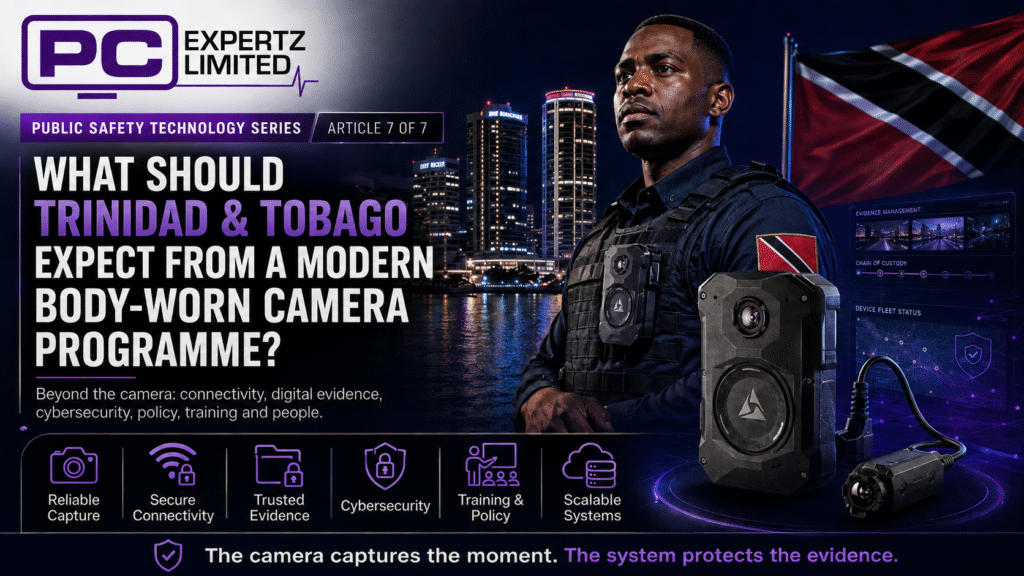
This is the seventh and final article in the PC Expertz Public Safety Technology Series. Over the past seven months in this series, we have looked beyond the camera itself. We explored digital evidence, officer protection, chain of custody, storage, retention and artificial intelligence.
The final question brings all of those pieces together. What should Trinidad and Tobago expect from a modern body-worn camera programme? The answer is much bigger than a camera attached to an officer’s uniform. A serious programme connects field technology, secure networks, digital evidence, cybersecurity, policy, training and people.
A Modern Body-Worn Camera Programme Starts With the Officer
The camera must first work for the officer wearing it. It should capture clear and useful evidence without creating unnecessary complexity during an already demanding situation.
Reliability therefore matters. So do battery performance, ease of operation, secure transfer and the ability to work in real-world conditions. Officers should focus on the situation in front of them, not on managing technology.
Training matters just as much as hardware. The U.S. Bureau of Justice Assistance notes that proper training can play a major role in the success of a body-worn camera programme. Different personnel also require different types of training.
The technology should support the officer. It should never become another obstacle between the officer and the job.
The Camera Is Only the First Part of the System
That principle has guided this entire series: the body camera is only the visible part of a much larger technology ecosystem.
After an officer records an incident, the video has to go somewhere. The system must transfer it securely, associate it with useful information and store it in a controlled environment. Authorized personnel must then be able to find it when needed.
This is why a modern body-worn camera programme in Trinidad and Tobago should consider the complete evidence lifecycle. It begins with capture, but it continues through transfer, storage, review, sharing, retention and eventual disposal.
The U.S. Department of Justice has long warned that agencies need policies, practices and officer training alongside the technology. Its implementation guidance also identifies data collection, storage and review as core considerations.
Connectivity Becomes Part of Public Safety Infrastructure
Body cameras create digital information, which means networking becomes part of the programme.
Depending on the system, footage may move through docking infrastructure, secure networks or other managed connections. Each path needs enough capacity to handle the volume of data reliably.
This is where traditional IT knowledge becomes important. Network performance, redundancy, authentication and monitoring may seem far removed from the camera on an officer’s uniform. In reality, they form part of the same system.
If a camera captures important evidence but the surrounding infrastructure cannot manage it properly, the technology has not completed its job.
Digital Evidence Management Becomes the Centre of the Programme
As deployments grow, the evidence platform can become more important than the individual camera.
Imagine hundreds of officers generating video across thousands of shifts. A simple collection of video folders would quickly become difficult to manage. Investigators need a structured evidence library.
A modern system should help authorized users locate recordings using information such as dates, incidents, officers or case references. It should also support controlled access and maintain records of activity.
The Bureau of Justice Assistance notes that implementing a body-worn camera programme affects many areas of an agency. These can include patrol, supervisors, investigators, legal personnel, evidence management, records and technology teams.
That is why body-worn cameras should not sit in isolation. They must connect with the wider investigative and justice process.
Evidence Must Remain Trustworthy
Recording an incident is only the beginning. A modern programme also needs to protect the integrity of that recording.
Organizations need to know who accessed evidence and what happened to it. They also need safeguards against unauthorized changes, copying or improper access.
Modern evidence practices can include audit trails, access controls and protections against tampering. BJA guidance specifically highlights access auditing, authority controls and technological safeguards as important considerations.
This creates accountability on both sides of the camera.
If footage supports an officer’s account, the system should help establish its integrity. If it supports a legitimate complaint, the same standard should apply.
Trusted evidence requires a trusted process.
Cybersecurity Cannot Be an Afterthought
Body-camera footage may contain sensitive information about officers, victims, witnesses and members of the public. That makes cybersecurity fundamental.
A modern body-worn camera programme needs strong identity management, permissions and secure storage. It also needs controlled methods for sharing evidence.
This becomes increasingly important as evidence libraries grow. More devices create more information, and more information creates a larger responsibility to protect it.
Cybersecurity should therefore start with the architecture of the programme. Adding it later is much harder.
Retention Requires Technology and Policy
Not every recording needs the same retention period.
Routine footage may follow one rule. Video connected to an investigation, complaint or court matter may follow another. The technology can help apply those rules, but policy must define them.
Retention also affects storage requirements. Keeping everything forever would create unnecessary growth. Removing evidence too early could create a different problem.
A mature programme therefore needs a clear evidence lifecycle. Agencies should know why footage remains stored, who can access it and when policy allows its removal.
Privacy Must Be Part of the Conversation
Body cameras may record people during some of the most difficult moments of their lives. That creates legitimate privacy questions.
A modern programme must therefore balance evidence requirements with appropriate privacy protections. Policy should guide when cameras operate, how footage gets accessed and how organizations handle sensitive recordings.
BJA’s Body-Worn Camera Toolkit identifies privacy as a major implementation issue. It also stresses that programmes should communicate clearly with the public about their goals, operation and limitations.
Technology can enforce controls, but policy establishes the boundaries.
Officers Need Confidence in the System Too
Public discussion often focuses on how body cameras hold officers accountable. That is only one side of the equation.
Officers also need confidence that the system handles their recordings fairly. Reliable video can provide important context when questions arise after an encounter.
However, cameras do not capture everything, and video still requires interpretation. An incident may involve events outside the camera’s field of view or moments before recording begins.
This is one reason expectations should remain realistic. National Institute of Justice research has found mixed results when studying the effects of body-worn cameras across different agencies and outcomes. Cameras can provide valuable evidence, but technology alone does not guarantee better policing.
Good implementation matters.
AI Can Help, but People Must Remain Responsible
As we explored in Article 6, artificial intelligence may help agencies manage rapidly growing evidence libraries. AI-assisted tools can support searching, transcription, redaction and categorization. These capabilities can reduce repetitive administrative work and help investigators locate relevant information faster.
However, AI should support human judgment rather than replace it. A system may help locate a recording or identify information within a transcript, but investigators still need to understand the wider context. Supervisors must still make decisions, and organizations remain responsible for how they use the technology.
This distinction will become more important as public safety technology develops. Automation can improve efficiency, but accountability should remain with people. The technology should help professionals work with information more effectively, not make critical decisions for them.
A Modern Programme Must Be Designed to Scale
A system that works well with a small number of cameras may behave very differently when hundreds of devices are operating every day. More cameras create more video, which means more network traffic, storage, searches, users and retention decisions.
For this reason, agencies need to think beyond the initial deployment. The surrounding infrastructure must be able to grow with the programme. Networks, storage, cybersecurity, software, user management and technical support all become more important as the amount of evidence increases.
Lifecycle planning matters as well. Cameras, batteries and other hardware will eventually need maintenance or replacement. Software will change, storage requirements will grow and personnel will require ongoing training. A modern body-worn camera programme should therefore be treated as a long-term technology environment rather than a one-time equipment purchase.
What Success Should Look Like for Trinidad and Tobago
A successful body-worn camera programme in Trinidad and Tobago should make the technology easier for officers and authorized personnel to use. Officers should be able to concentrate on the situation in front of them without worrying about whether the camera or surrounding system will work correctly.
Investigators should be able to locate relevant evidence without manually searching through thousands of files. Supervisors should have clear controls over access, while evidence personnel should be able to manage retention and sharing through defined processes. At the same time, IT and cybersecurity teams should have the tools needed to protect the systems behind the programme.
The justice system also benefits when digital evidence has a clear history from capture through review. Reliable audit trails, controlled access and evidence-integrity measures can help establish confidence in how a recording was handled. For the wider public, this can support greater confidence that important interactions are documented and managed through a structured process.
That should be the goal. A modern programme should work for the officer, the investigator, the organization, the justice system and the public at the same time.
Why PC Expertz Is Talking About Body-Worn Camera Technology
PC Expertz has worked with connected technology in Trinidad and Tobago for more than two decades. Our work has involved CCTV, networking, cybersecurity, cloud systems, managed IT and increasingly, public safety technology.
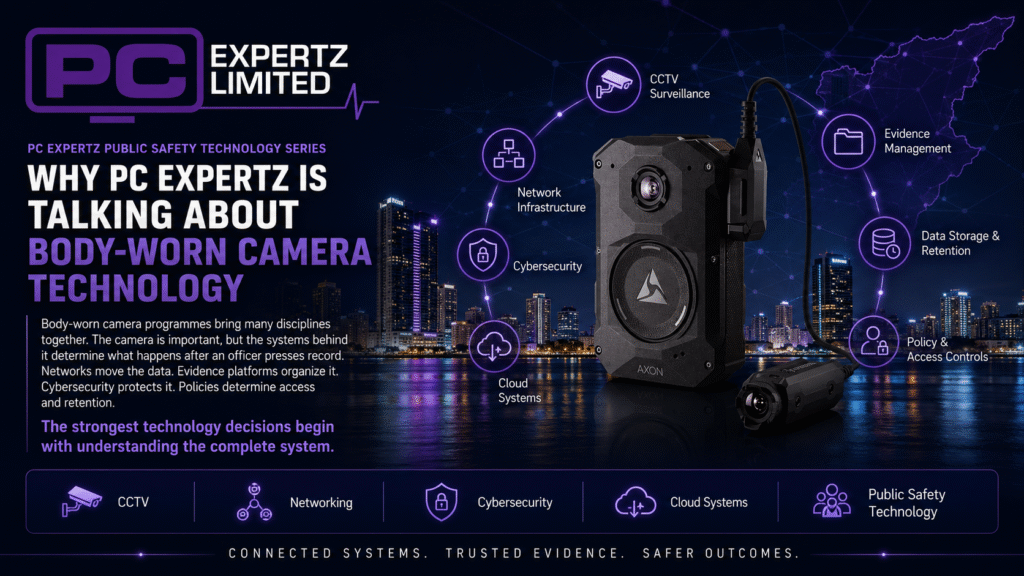
Body-worn camera programmes bring many of those disciplines together. The camera itself is important, but the systems behind it determine what happens after an officer presses record. Networks move the data. Evidence platforms organize it. Cybersecurity protects it. Policies determine access and retention, while trained personnel ultimately decide how the evidence should be used.
That is why this series has focused so heavily on the technology surrounding the camera. Understanding the full architecture provides a much clearer picture of what a serious body-worn camera programme requires.
For organizations considering public safety technology, this wider view matters. The strongest technology decisions usually begin by understanding the complete system rather than focusing on one device.
The Camera Is Only the Beginning
Across this seven-part series, one idea has remained consistent: a body-worn camera is much more than a camera. It is the starting point of a digital evidence process that may involve officers, supervisors, investigators, evidence personnel, IT teams and the wider justice system.
A modern body-worn camera programme in Trinidad and Tobago should therefore deliver more than video recording. It should provide reliable capture, secure connectivity, controlled evidence management, strong cybersecurity and clear accountability. It should also support sensible retention policies, effective training and infrastructure that can grow as the programme develops.
Most importantly, the technology should serve the people who depend on it. Officers need systems they can rely on. Investigators need evidence they can find and trust. Administrators need processes they can manage, while the public deserves confidence that important recordings are handled responsibly.
The camera captures the moment, but everything that happens afterwards determines the real value of that recording. The network moves it, the evidence platform protects and organizes it, policy governs it and people ultimately interpret what it means.
That is the bigger picture behind modern body-worn camera technology, and it is the central idea we wanted to explore throughout the PC Expertz Public Safety Technology Series.
After seven articles, our conclusion is straightforward: the camera may be the most visible part of the system, but the technology, infrastructure, security and people behind it are what make the evidence useful and trustworthy.
Navigation Links
Part 1: Body Cameras Are Changing Public Safety. But the Camera Is Only Half the Story.
Part 2: What Happens to Body-Camera Footage After an Officer Stops Recording?
Part 3: Can Body Cameras Protect Police Officers Too?
Part 4: From Body Camera to Courtroom: Can You Trust the Digital Evidence?
Part 5: What Happens When Thousands of Hours of Body-Camera Video Start Piling Up?
Part 6: AI and Body Cameras: The Next Stage of Digital Evidence
Part 7: What Should Trinidad & Tobago Expect From a Modern Body-Worn Camera Programme?
WhatsApp: +1 (868) 798-9762
Email: admin1@pcexpertz.com
Website: pcexpertz.com