
What Happens When Thousands of Hours of Body-Camera Video Start Piling Up?

This is the fifth article in the PC Expertz Public Safety Technology Series. In our previous article, we followed body-camera footage from capture toward the courtroom. We looked at chain of custody, audit trails and the controls that help protect digital evidence.
Now we face another challenge: scale. A few body cameras may produce a manageable amount of footage. However, as a programme grows, hundreds of cameras can create thousands of hours of video. At that point, body camera evidence management becomes just as important as recording the incident.
Every Camera Creates More Data
A body-worn camera can record significant amounts of video during normal operations. Multiply that across many officers, shifts and locations, and the amount of data grows quickly.
The challenge is not simply finding enough storage space. Agencies also need to organize, protect and retrieve that information. Some footage may relate to routine activity, while other recordings may become important evidence.
This means every recording needs context. The system may need to associate footage with an officer, date, incident, case or location. Without that structure, a large video library can quickly become difficult to manage.
Storage Is Only the Beginning
It is easy to think of this as a storage problem. In reality, storage represents only one part of body camera evidence management.
A modern evidence environment also needs to control access and apply retention rules. It must support searching, audit activity and secure sharing. At the same time, the system needs to preserve evidence integrity.
Simply keeping thousands of video files in folders would not solve these problems. The footage needs an organized environment that can manage its entire lifecycle.
Finding the Right Recording
Imagine an investigator needs footage from an incident that occurred several months ago. By then, an agency may have collected thousands of additional recordings.
Searching through folders manually would consume valuable time. Therefore, evidence systems need ways to organize and locate recordings efficiently.
Metadata can help provide that structure. A recording can include information such as date, time, officer, device or case reference. Authorized users can then use this information to narrow their search.
Good organization turns a large video archive into a usable evidence library.
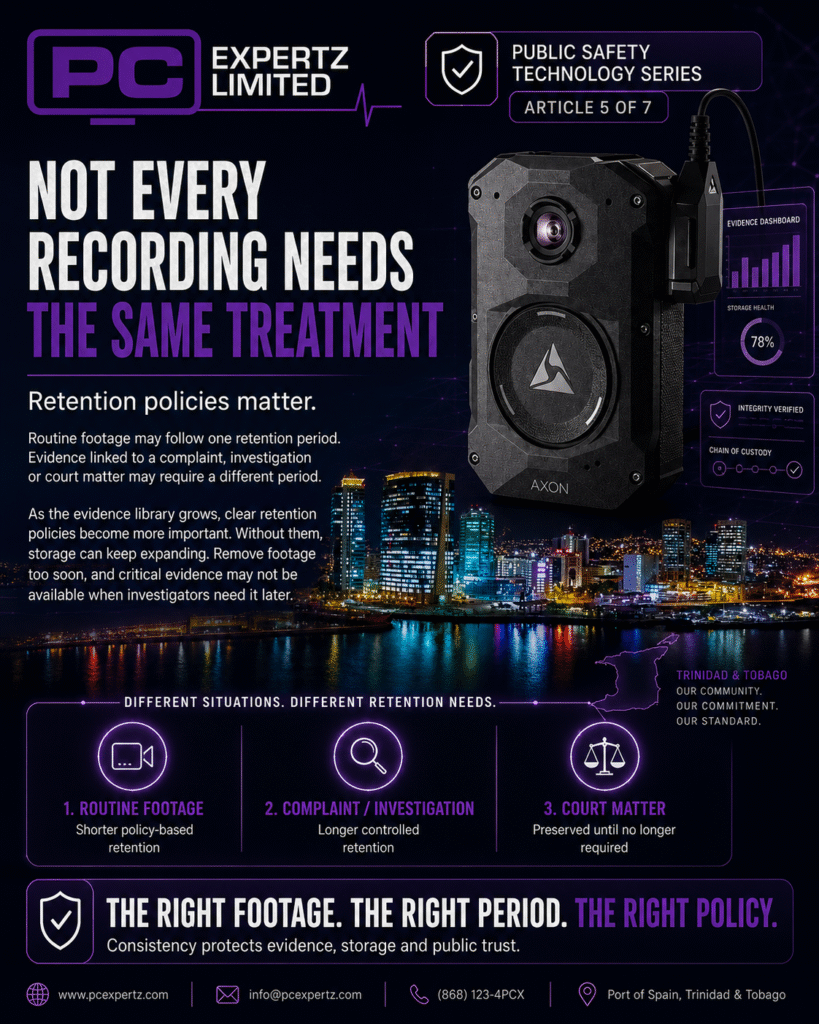
Not Every Recording Needs the Same Treatment
Another challenge involves retention. Not every video needs to remain in storage for the same length of time.
Routine footage may follow one retention policy. Evidence linked to a complaint, investigation or court matter may require a different period. A system can help organizations apply those rules consistently.
This becomes more important as the evidence library grows. Without clear retention policies, storage requirements can continue expanding. However, removing footage too soon can create serious problems when investigators later need it.
Technology and policy must therefore work together.
Access Also Becomes More Complex
A larger evidence library usually means more people may need controlled access to different recordings. Investigators, supervisors and other authorized personnel may each require different permissions.
Role-based access can help manage those requirements. Instead of giving everyone access to everything, the system can limit users to the information they need.
Audit trails add another layer of accountability. They can record who accessed evidence and what actions they performed. As the amount of stored footage increases, these controls become increasingly important.
Cybersecurity Grows With the Evidence Library
Thousands of hours of body-camera footage may contain sensitive information about officers, victims, witnesses and members of the public. Therefore, protecting the evidence library becomes a significant cybersecurity responsibility.
Organizations need safeguards around storage, user accounts and access permissions. They also need processes that help prevent unauthorized access or inappropriate sharing.
The larger the evidence environment becomes, the more important these controls become. Body camera evidence management is therefore not only about efficiency. It is also about protecting sensitive information at scale.
The Human Problem of Too Much Video
Technology can store enormous amounts of footage. Human beings, however, still have limited time.
An investigator cannot realistically watch thousands of hours of video to find one relevant moment. Supervisors face the same challenge when reviewing incidents or searching for information.
This creates an important distinction between storing evidence and actually being able to use it. A successful system must help authorized users get from a large evidence library to the information they need.
Search tools, categorization and structured workflows can reduce that burden. As body-camera programmes expand, these capabilities become increasingly valuable.
Scale Changes the Technology Requirement
A small deployment can sometimes hide weaknesses in a system. Manual processes may still work when only a limited number of recordings exist.
Scale changes that.
When hundreds of devices begin generating footage every day, inefficient processes become much more visible. Uploading, categorizing, reviewing and retaining evidence all require greater structure.
This is why a mature body-worn camera programme depends on more than the cameras themselves. The infrastructure behind those cameras must grow with the amount of evidence they produce.
What This Means for Trinidad and Tobago
For Trinidad and Tobago, the discussion around body-worn cameras should also include the long-term management of digital evidence. As the number of cameras increases, so will the volume of footage that agencies must handle.
The real challenge is not simply where to store that video. It is how to keep the evidence organized, secure and accessible to authorized personnel when they need it.
A scalable approach can help manage storage, retention, cybersecurity, access and evidence integrity together. That creates a stronger foundation for officers, investigators and the wider justice system.
When Video Becomes a Data Challenge
Body cameras create valuable evidence, but every recording adds to a growing digital library. Eventually, the challenge shifts from capturing video to managing information.
Effective body camera evidence management helps make that scale manageable. It gives structure to large amounts of footage while supporting security, accountability and retrieval.
The objective is not to keep more video simply because technology allows it. The objective is to ensure that important evidence remains protected, organized and available when it matters.
Recording the moment is only the beginning. At scale, finding and managing that moment becomes the real challenge.
In the next article in our PC Expertz Public Safety Technology Series, we will look at where this technology may go next: AI and Body Cameras: The Next Stage of Digital Evidence.
Navigation Links
Part 1: Body Cameras Are Changing Public Safety. But the Camera Is Only Half the Story.
Part 2: What Happens to Body-Camera Footage After an Officer Stops Recording?
Part 3: Can Body Cameras Protect Police Officers Too?
Part 4: From Body Camera to Courtroom: Can You Trust the Digital Evidence?
Part 5: What Happens When Thousands of Hours of Body-Camera Video Start Piling Up?
Part 6: AI and Body Cameras: The Next Stage of Digital Evidence
Part 7: What Should Trinidad & Tobago Expect From a Modern Body-Worn Camera Programme?
WhatsApp: +1 (868) 798-9762
Email: admin1@pcexpertz.com
Website: pcexpertz.com